
Altered States in ICU
Dr Martyn Stones is a Psychiatry trainee and PhD student in the Division of Psychological Medicine and Clinical Neurosciences in the School of Medicine at Cardiff University.
As part of his PhD, he has created a book which chronicles people’s experiences of delirium while in the Intensive Care Unit (ICU).
Delirium is a common condition affecting about 20% of all hospital patients. Symptoms fluctuate and include poor attention, disorientation and in severe cases, visual hallucinations and paranoia.
These symptoms can be very distressing, and the patient cannot go home until they have resolved. The cause of delirium is poorly understood, but it is more common in the elderly and severely ill. There are no blood tests or medicines specifically designed for the treatment of delirium, and the government (NICE) has identified that research is urgently needed.
Understanding delirium
So what is delirium? The word “delirium” is used to describe a severe state of confusion.
People with delirium:
- Cannot think clearly
- Have trouble paying attention
- Have a hard time understanding what is going on around them
- May see or hear things that are not there. These things seem very real to them.
- Delirium also often causes patients to feel frightened, angry, lonely and ashamed.
Delirium is common. About two out of three patients in ICUs experience delirium, with seven out of 10 patients getting delirium while they are on a breathing machine or soon after.
Experts think delirium is caused by a change in the way the brain is working. This can be caused by:
- Less oxygen to the brain
- The brain’s inability to use oxygen
- Chemical changes in the brain
- Certain medicines
- Infections
- Severe pain
- Medical illnesses
- Alcohol, sedatives, or painkillers
- Withdrawal from alcohol, nicotine
Chronicling the visual hallucinations described by patients
Dr Martyn Stones, as part of his PhD, is investigating the biochemistry of delirium in Cardiac Intensive Care. Dr Stones collected the experiences of patients who developed distressing psychotic symptoms, including confusion, visual hallucinations and paranoia.
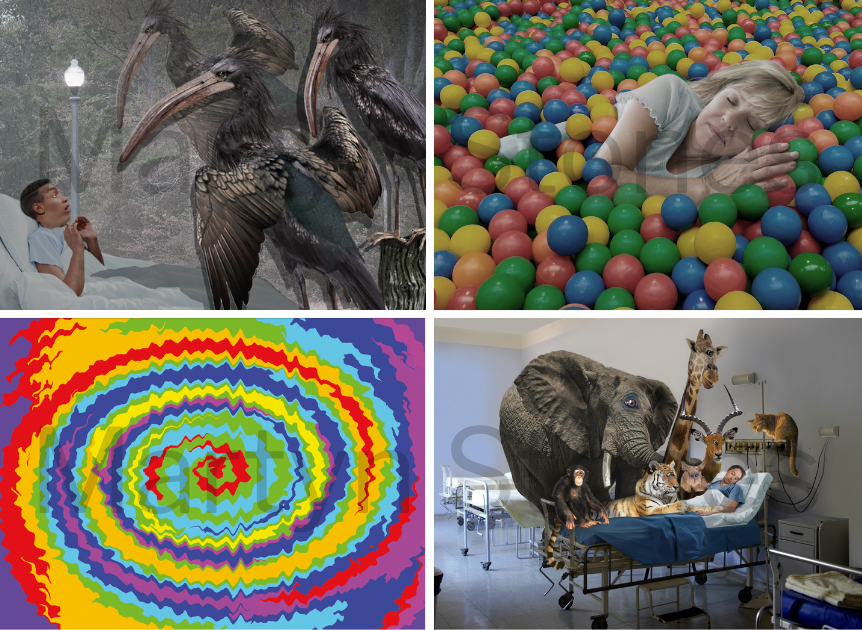
To capture these experiences, Dr Stones worked with Jan Sharp, the Senior Medical Artist in the Department of Medical Illustration in the University Hospital of Wales, Cardiff, who produces images of the patients’ hallucinations.
Dr Stones explained, “This book is aimed at student doctors, nurses and other ward-based disciplines. Experienced ward staff may also get a better understanding of the patients’ perspective and use the book to help patients and their families understand the visual symptoms experienced during delirium. The book may be of benefit to the public and researchers interested in altered states of consciousness.”
The Cardiff Delirium Study
This study aimed to investigate the relationship between the biological and psychological changes that occur in patients in intensive care after heart surgery. Patients who agreed to participate in the study described their visual hallucinations to Jan Sharp, the medical artist.
Layers of photographs were distorted, overpainted and combined using Adobe Photoshop and digital airbrushing techniques to create these strange, dream-like scenes, in an attempt to accurately represent the hallucinations and enable viewers to experience what they saw.
Dr Stones explained,
You will notice that many of the hallucinations existed against the background of the ICU but this was not true of all the images collected. Many were fantastical hallucinations not related to the ICU, others were simple colours and shapes. Out-of-body and a near-death experience were also captured.
We are very grateful to the patients who agreed to help with the study during this very challenging time and for the support of the clinical staff who made the study possible.”
The images are currently on show in the foyer of the Hadyn Ellis Building on Maindy Road in Cardiff.
Watch a flick through of the Altered States book
The project team
Dr Martyn Stones is a Psychiatry trainee and PhD student.
Department of Psychological Medicine and Clinical Neurosciences, School of Medicine, Cardiff University.
Jan Sharp is the Senior Medical Artist
Department of Medical Illustration, University Hospital of Wales, Cardiff.
Contact the team
You can contact Dr Stones by emailing delirium@cardiff.ac.uk
Useful links
- Virtual Reality (VR) Delirium Training from Health Education and Improvement Wales